
A turn costs more than a shot
Three action points a turn. Eight items out of twenty-four. Ground you can dig through, collapse, flood and freeze.
Free and with nothing to install. An opponent is found in fifteen seconds — and if no human is around, you play a bot.
A turn is a plan,
not a press of the space bar
You have 3 action points a turn, and everything costs points: firing, driving, digging in, building, tunnelling, blowing a support, focusing and turning around. In one turn you cannot drive, dig in and fire a heavy shell.
Unspent points carry over, up to 5. Banking is worth exactly one turn, and only for a specific plan.
The ground comes apart
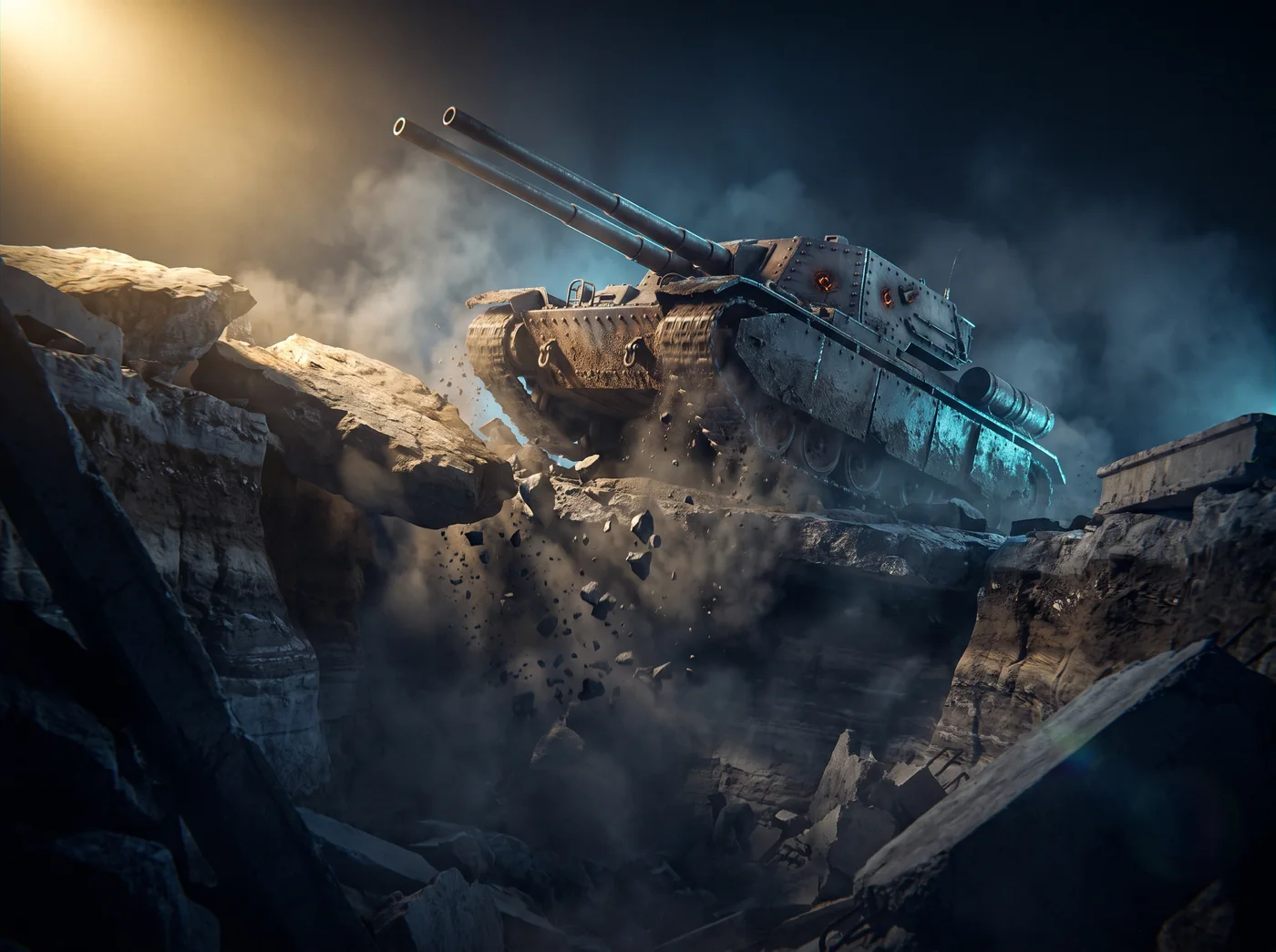
Eight kinds of ground, each with its own crater, ricochet and cost to drive across. Stone cannot be dug, marsh damps a blast by half, ice gives a crater twice as wide and carries the machine down the slope.
You can tunnel a hill through, drop a ledge on someone's head, build a bridge or breach a dam and flood the valley. A crater stays until the end of the battle, and the enemy sees it.
Eight slots out of twenty-four
Damage is only one of five roles. Terrain, control, intel and defence take the same slots and cost the same points, which is why building a loadout decides the outcome as much as aiming does.

Eight ways to take health off — from a cheap shell to a salvo that needs a turn of preparation.

A weapon against the map: dig, collapse, dissolve, build.

Take away a turn, a point or the ability to drive off. Almost no damage — that is the point.

Learn the enemy loadout, the wind three turns ahead — or hide yourself.

A turn without firing that pays off only if the enemy fires.
Built for the conditions
The arena, the weather and the arena rule are named before you build — so there is no such thing as a universal loadout.
The whole arsenalForty machines, three branches
The branches are the same three roles the battle is built around. A machine's character opens up with rank: at the first the Fortress and the Blade still look alike, at the tenth they are two different games.

Takes the most punishment and digs the widest: a bigger crater means the terrain is a weapon.

Hits hardest and first: the price of a miss is higher, and so is the reward for precision.

Drives farthest: position beats firepower, and it leaves a foxhole alive.
 BASTION
 OUTPOST
 REDOUBT
 BASTILLE
 CITADEL
 MONOLITH
 COLOSSUS
 TITAN
 REACTOR
 LEVIATHAN
 SPARK
 STING
 RAPIER
 INFERNO
 HARPY
 EDGE
 POLEAXE
 GUILLOTINE
 TEMPEST
 HAZE
 MURK
 MIRAGE
 HOARFROST
 PHANTOM
 WHIRL
 SILHOUETTE
 ECLIPSE
 SHADOW
Six formats, and each changes a decision
A format is not a multiplier on the numbers but a different set of rules: in one there is no time, in another no arsenal, in a third a blast does not break armour at all.

The standard battle: three points a turn, eight slots, the whole arsenal

Ten seconds a turn, two points, four slots — a match in three minutes

Basic shell only, unlimited ammo: pure gunnery

Blasts do not touch armor: only the ground kills — collapse, falling, water

One digs in and holds, the other assaults against the clock; then they swap

Waves of enemies, each stronger than the last; your score is the wave count
Weather changes the physics, the arena rule changes the map
The same loadout plays differently in snow with high drift and in heat on scree. Both are named before you build, not discovered mid-battle.

Baseline. Wind drifts gently, ±10 a turn

Blasts are 25 % weaker, every surface is slippery, snow piles up

Shells fly 15 % farther, fire burns twice as long

Wind jumps ±60 between turns and shifts mid-flight

Craters are 40 % deeper, slopes creep, fire dies within a turn

You see only 30 % of the enemy arc, their power is hidden

Water rises every three turns. The low ground goes first; height decides

Half the ammo for everything except the basic shell

Wind up high is twice as strong: a lobbed shot catches it three times over

The whole map is sand: craters half again as wide, slopes creep — the ground kills more often than the shell
What it looks like in practice
Three screens an evening passes between: the hangar, the battle and the review after it.


What has arrived in the game
Briefly: what changed and how it affects the battle.
Six kinds of weather and four arena rules are now named in the briefing before you build the loadout. Building a universal one is no longer possible.

Three branches of nine ranks and a common starter. A locked node says not only how much XP it costs, but how many battles that is for you.
Blitz, Sniper, Sapper, Siege and Survival. Each changes the rules, not the numbers.
Your first battle, right now
An opponent is found in fifteen seconds, and one battle takes five to twelve minutes.